
Legal Spec Breakdown - LSB
Turning regulatory obligations into a scalable human + AI workflow
What this project was
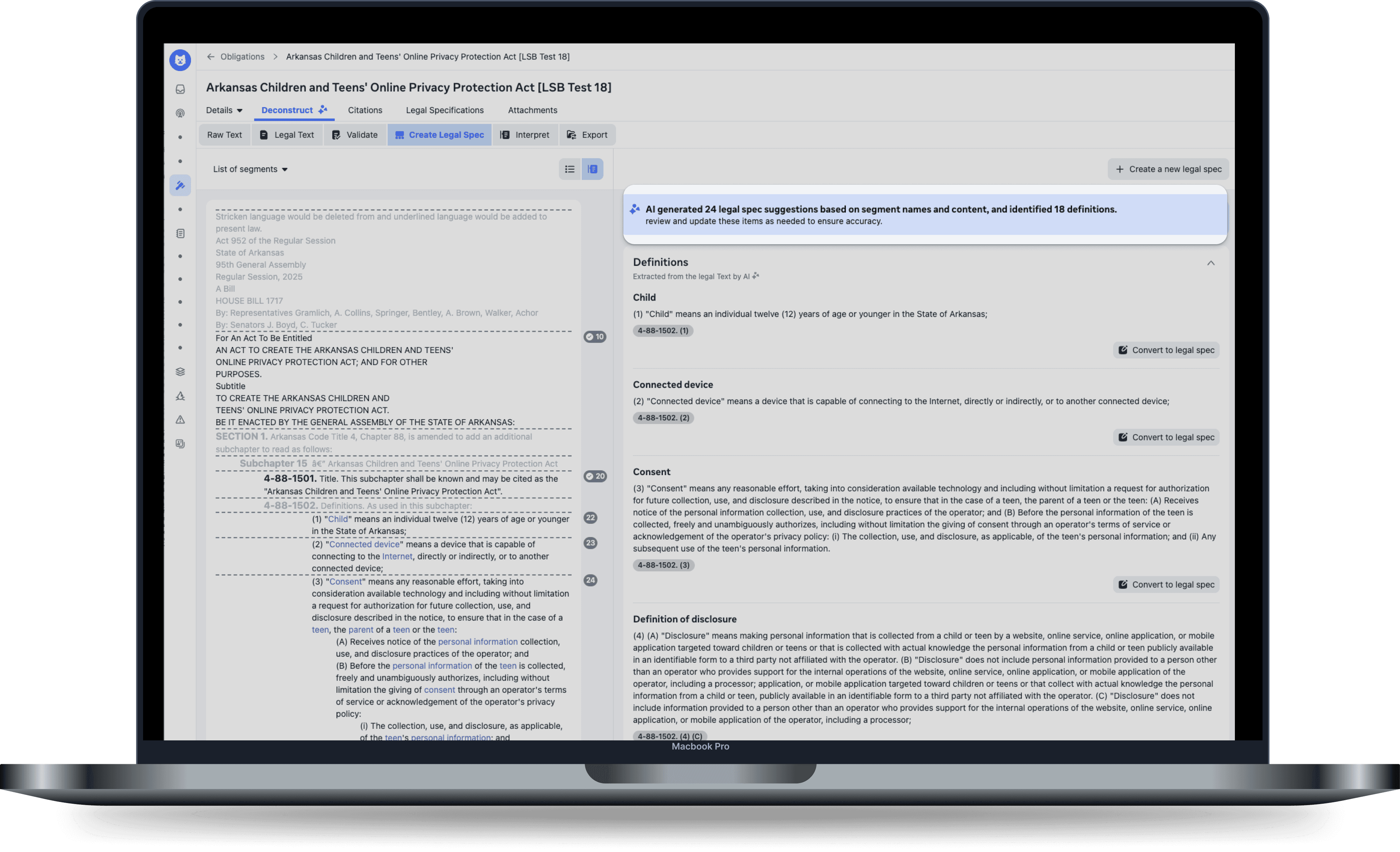
Legal Spec Breakdown was an AI-assisted internal platform that helped Meta deconstruct complex regulatory obligations into structured legal interpretations and implementation guidance.
When a new law created obligations for Meta, teams previously had to break down legal text manually, a process that could take weeks. LSB accelerated that work into hours, helping teams understand what the obligation meant, what required review, and how downstream product teams could prepare a response plan.
At a glance
Challenge
Legal deconstruction was manual, inconsistent, and handled outside the product ecosystem, making it difficult to scale as law volume and complexity increased.
Approach
I defined the product and workflow model for LSB, translating a high-stakes legal process into an AI-assisted system that balanced automation with human judgment across Validate, Create Legal Spec, and Interpret.
Impact
Established a more structured, scalable approach to legal deconstruction, validated through successful pilots, early AI usefulness signals, and a stronger foundation for future automation.
Why this mattered
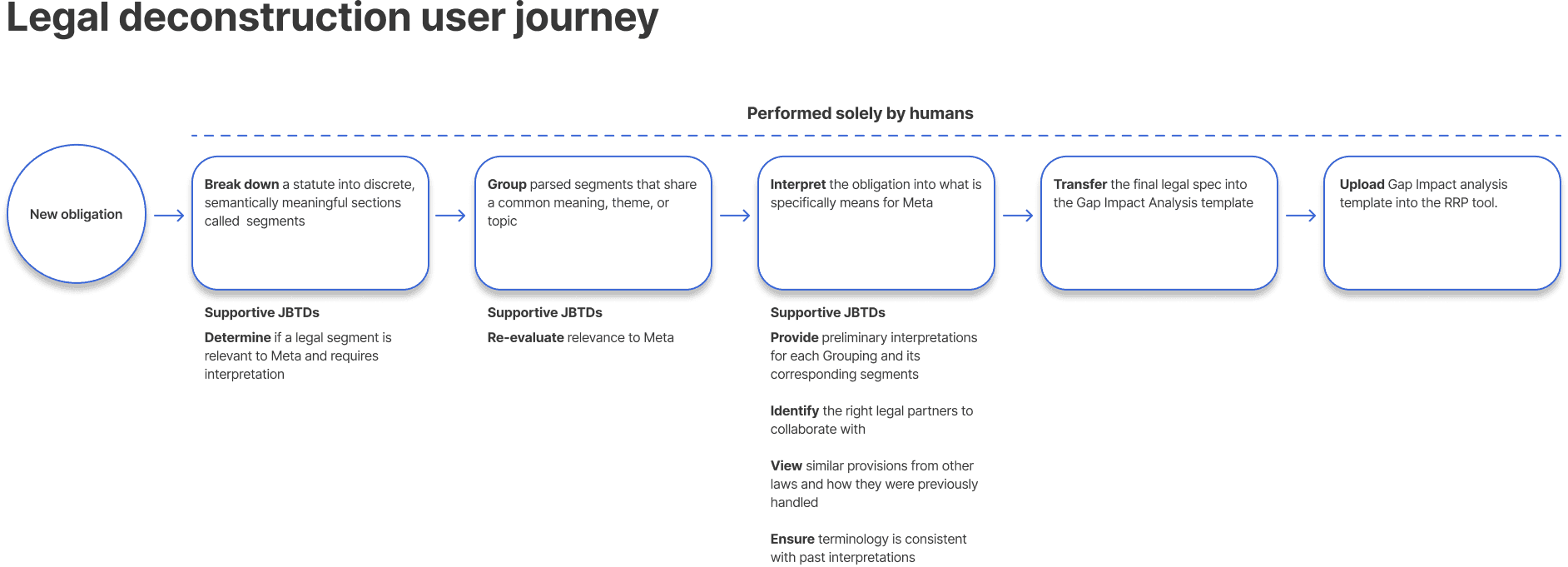
What looked like a manual workflow problem was actually a system design problem. Legal teams were deconstructing laws outside the product ecosystem, using inconsistent practices that made the process difficult to scale, hard to track, and vulnerable to variation in quality.
As law volume and complexity increased, solving this required more than automation. It required defining how AI and humans should collaborate in a domain where consistency, defensibility, and judgment matter.
At stake
Scalability: Manual deconstruction could not keep pace with growing law volume and complexity.
Consistency: Non-standard practices increased variation across interpretations and downstream workflows.
Defensibility: Legal outputs needed to be clear, traceable, and grounded enough to withstand scrutiny.
Operational leverage: Without a productized system, progress remained difficult to measure and improve over time.
What I led
Defined how AI and humans should collaborate across the legal deconstruction workflow
Translated research insights into design principles, workflow structure, and boundaries between human and AI responsibility
Helped shape prompt strategy and evaluation criteria using a research-based failure mode ontology
Designed a flexible system that supported defensibility, iteration, and legal judgment without over-standardizing the process
Four strategic moves
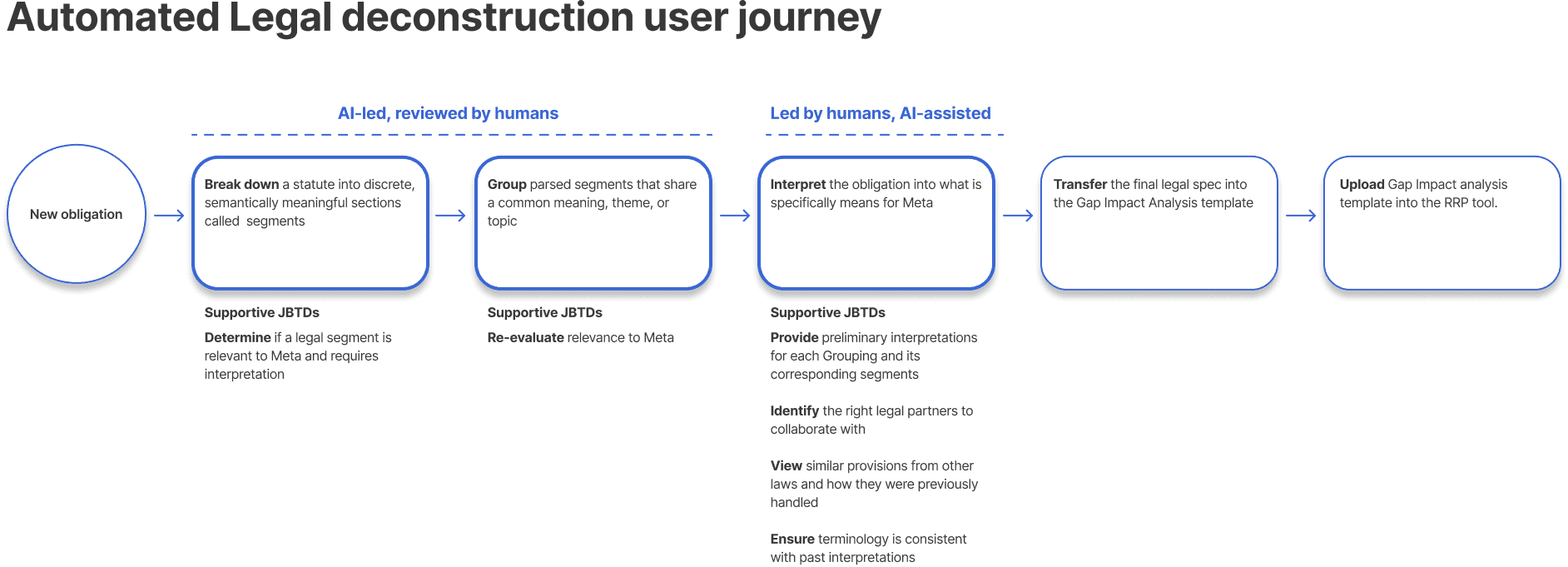
Move 1 - Modeled human + AI collaboration
I structured the system around three modes — Validate, Create Legal Spec, and Interpret — each with a different balance of automation, review, and authorship.
Move 2- Used research to shape the product and AI system
Research informed not only the UX, but also the prompt strategy, evaluation structure, and failure modes used to assess interpretation quality.
Move 3- Designed for defensibility, not rigid automation
Rather than optimizing for full automation, I designed the system so every AI output remained reviewable, traceable, and open to Legal's judgment. Speed without defensibility would have undermined the whole point, Legal needed to be able to stand behind every interpretation the system produced.
Move 4- Designed for visibility without premature action
Leadership needed to give downstream teams earlier visibility into AI-generated legal interpretations while ensuring they wouldn't act on unvalidated output and create rework. I designed the system that solved that tension, surfacing AI drafts in a way that informed planning without signaling readiness, within a 7-day Legal review SLA set by the Director of Legal.
Impact
This work was earlier-stage than a mature consumer launch, so the strongest proof points were around workflow readiness, pilot validation, and AI usefulness rather than large-scale business metrics.
Early proof of value
6/6 laws were successfully deconstructed end-to-end using LSB, meeting pilot success criteria
AI suggestions were rated as more helpful than neutral across key legal tasks including validation, legal spec creation, relevancy, and interpretation
The product established a clearer and more measurable system for legal deconstruction than the prior manual process
Research, prompt strategy, and evaluation work created a stronger foundation for future AI maturity and downstream automation
I was brought in to apply the same standardize-and-automate method to the next stage of the pipeline, Gap Impact Assessment (GIA), which had the same problem: a disparate, fully manual process with no shared taxonomy across teams. The same approach worked again. That's not a coincidence, it's evidence that what was built here wasn't a one-off fix, but a reusable method.